

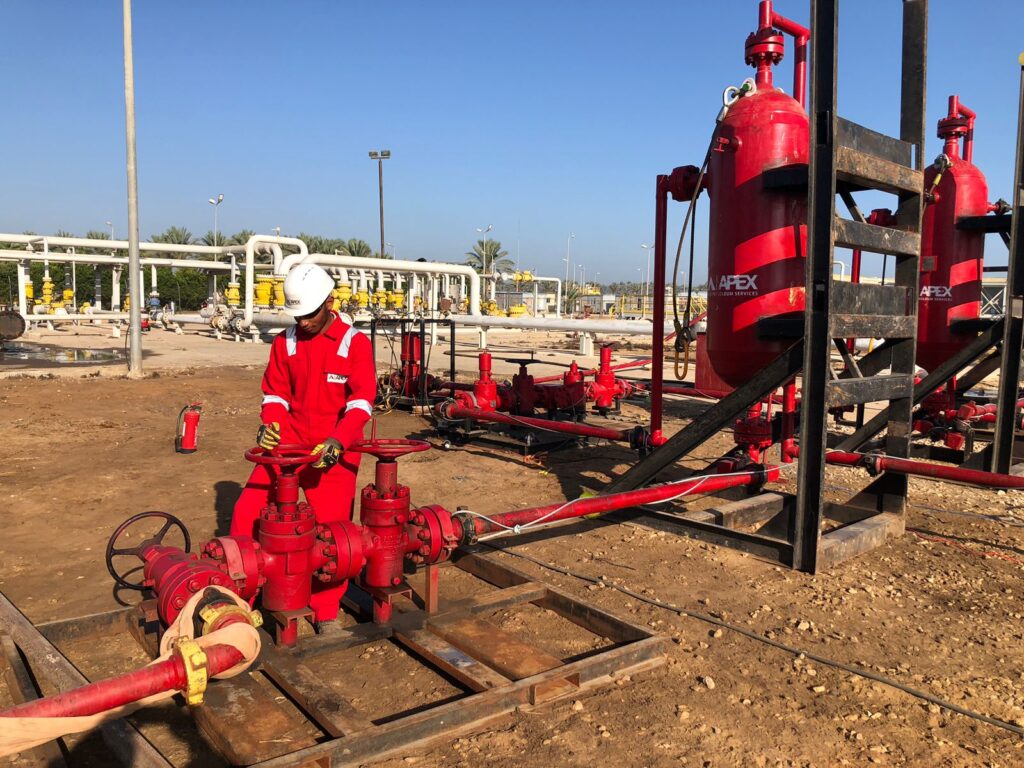
The Apex Petroleum Services Wellhead desander is designed to remove sands and solids present in well effluent. Wellhead desander is the first sand management equipment on the surface where gases and fluids come into contact with surface equipment after X-mass Trees. Cyclonic desander applies centrifugal (axial) and gravitational forces to perform solid separation. Desanders are usually equipped with instruments, such as pressure gauges, temperature gauges, differential pressure gauges, and other probes and transmitters based on the client’s requirements.
Features and Benefits:
- ASME Section VIII Div.1
- National Board Registered
- High separation efficiency of removing particles from the liquid or mixture, down to 1.5 to 3 microns.
- Efficiency 94-97%
- Nace Certified
- Full X-Ray Examination
- Ultra Sonic & Hydrostatic Testing
- AS Built Verification custom engineered
- Modular/Compact Design allows for quick and easy installation
Operations:
Well fluids flow from the wellhead into the cyclone liner within the upper desander vessel, where centrifugal force separates sand from the fluid. Clean fluids exit through the overflow line, while sand settles into the lower accumulator. Once full, the accumulator is isolated, depressurized, and flushed using service water into a sieve tank. During this time, sand continues to collect in the upper vessel, allowing continuous well flow without shutdown. After flushing, the vessels are equalized, and the cycle resumes.
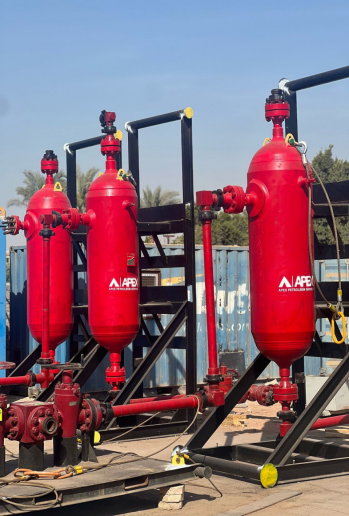
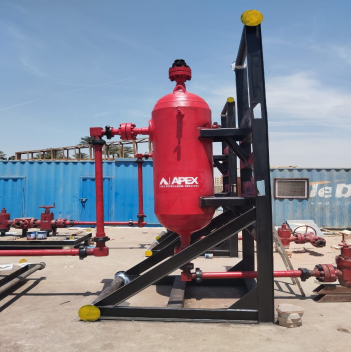
| Desander Specifications | |
| Working Pressure (psi) | 10,000 |
| Internal Diameter | 17” |
| External Diameter | 28” |
| PSV Connection | Yes |
| Inlet/Outlet Size | 2-4” |
| Flow Rate (max) | |
| Gas (MMScf/D) | 30 |
| Liquid (BBL/D) | 2500 |
| Foot Print | 4’x5’ |
Meets requirements of NACE MR0175.
Working temperature°F (°C) -20 to 350 (-29 to 177)
Other sizes, configurations, and pressure ratings are available to meet most applications.
These ratings are guidelines only. For more information, consult your local Apex Petroleum Services representative.